Tonight on “Here and Now,” an update from Wisconsin Emergency Management on potential flooding threats due to all this rain and snow-pack to the north.
Also, Act 10 reaches into county jails. Many counties are reclassifying jail guards from “protective status” employees to “general employees.” This means increased contributions toward benefits and loss of duty disability pay. We’ll hear both sides of this issue.
And the U.S. Supreme Court ruled this week that police must obtain search warrants to conduct blood alcohol tests for suspected drunk drivers. We check in with the Sheboygan County District Attorney for his take on what this will mean going forward.
In our Budget Watch series, the Executive Director of the Wisconsin Taxpayers Alliance, discusses Governor Scott Walker’s income tax cut, proposed in the 2013-15 state budget.
That’s tonight at 7:30 p.m. statewide on Wisconsin Public Television.
What’s On Tonight?
School Voucher Campaign $
My last couple of reports on Gov. Scott Walker’s proposed budget have focused on public education. A large element of the Governor’s changes involve expanding school vouchers. First, Gov. Walker wants to expand school choice beyond the current districts of Milwaukee and Racine, adding nine more districts over the next two years.
Governor Walker also wants to increase the value of the voucher. Currently, private and parochial schools receive $6,400 in taxpayer money for each voucher student, but the Governor would increase that to more than $7,000 for grades K-8 and $7,800 for high school students.
Next, Governor Walker wants to create a special needs scholarship program, which is vouchers for special education students. That would be a statewide expansion.
This isn’t the first time Governor Walker has moved to expand school choice. In his first budget the Governor expanded choice to Racine and also raised the income levels to allow middle income families to receive vouchers.
Governor Walker is clearly a believer in school choice, and school choice supporters clearly believe in him. A recent report (http://www.wisdc.org/pr040513.php#tbl1) from the Wisconsin Democracy Campaign tracks the amount of money that voucher supporters have spent on Wisconsin elections in recent years. Governor Walker received the most money by far, receiving $1.2 million since 2003. Most of that money came during his recall election when contributors could donate as much as they wanted to. It should also be noted that many of these donors support Governor Walker for other reasons besides school choice, they donate to all manner of conservative candidates.
The report highlights what most following the issues have known for years, school choice supporters are twice as likely to be out of state millionaires and their money goes to support Republicans or conservative candidates for the Supreme Court. The biggest names on the list include the heirs to Amway and Walmart. There are some Democrats (primarily from Milwaukee) who have received money from school choice groups, but they have not received the $10,000 minimum since 2003 to make it on the Democracy Campaign’s list.
School choice supporters say their money is used to balance out the contributions of public teacher unions, who for obvious reasons oppose school choice.
Budget Watch, Spearfishing and Capitol Book
Tonight on “Here and Now,” Zac Schultz continues our Budget Watch series with a report on private school vouchers for special needs students.
Also tonight, an excerpt from the annual State of the Tribes address, and a discussion on spearfishing in the north.
Plus, the authors of the new book, “More Than They Bargained For,” about Governor Scott Walker’s contentious Act 10 legislation that brought the Capitol to its knees.
“Here and Now,” statewide tonight at 7:30 p.m.
Meeting a freshwater rock star
It wasn’t a concert or touring show that packed Madison’s Capitol Theater Tuesday night. Seven hundred or so people turned out on a miserable rainy night for a lecture about water.
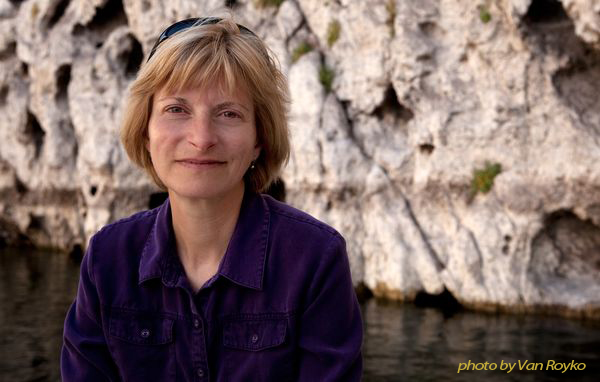 The star attraction was Sandra Postel, founder of the Global Water Policy Project and a Freshwater Fellow with the National Geographic Society. The occasion was the kick-off of the Wisconsin Academy of Sciences, Arts and Letters’s Waters of Wisconsin (WOW) initiative.
WOW is an encore of sorts to a previous Academy effort a decade ago. Then there was the recognition that water could not be taken for granted, and efforts like the Great Lakes Compact have since offered some protection for the resource. But WOW, the next generation, is coming at a time when pollutants like phosphorous are creating enormous threats to the health of lakes and rivers.
Steve Carpenter of the UW Center for Limnology referenced the stormy weather in his introductory remarks to Postel’s talk, noting that the rain falling now will become agricultural runoff. Eventually the water will carry nutrients to lakes and rivers where toxic algae will bloom in summertime.
Pollution is measured in terms of dilution, Carpenter offered, and while we think of Wisconsin as water-rich, in terms of unpolluted water, we are as water-poor as New Mexico.
When Postel took the stage, she offered many similar staggering snippets revealing the the severity of our global water crisis. Wetlands in Wisconsin and around the world have been reduced by half. The loss of that natural sponge effect wetlands provide may well have been a contributing factor to the devastation of the most recent rounds of flooding on the Mississippi.
Large dams, which can disrupt the ecological balance of river systems, have increased in number ten-fold since 1950, from about 5000 to 50,000. While in about the same time span, groundwater depletion has doubled.
On the large screen behind her, Postel showed images of the Aral Sea, the classic  ecological case study in imprudent resource management. After the Soviet Communist regime diverted the rivers feeding the Aral Sea-once the world’s fourth largest lake-in the 1950s to irrigate cotton fields, it began to disappear. But the recent rate of its decline was shocking to see, as, like a repeating animated GIF, aerial views from 2006 and then 2009 keep dissolving over one another showing a lake’s frightening disappearing act.
Framing her talk with the assertion that for the next decades the human story will be a water story, Postel posited that we need a better understanding of the hidden cost of water use. Would you rethink buying that cotton tee shirt if you knew its production took 700 gallons of water?
Consumer behavior is a large part of the conservation picture, but somewhat more macro economics play a part as well. Borrowing a term usually related to industry, Postel talks about water systems as ecological infrastructure. Here, there are some success stories, like Boston’s conservation efforts that have reversed the trend of growing use with growing population. And protecting the quality of New York City’s upstate water supply has saved millions in water treatment expense.
Postel characterized this as investment in watershed services, a reframing that speaks more to real economic cost.
There is also hope in technology, Postel assured the crowd, from micro-irrigation that delivers water directly to roots without the waste of wide dispersal, to improvements in desalination that can make saltwater fresh.
In her conclusion, Postel said “So, yes, there is hope. It is that we will come to know that the soft rain, and flowing water are undeserved, but precious gifts of life.”
And with that, 700 hundred people went back out into a rain that wasn’t that soft, but likely much more appreciated.
Sen. Schultz To Get Primary Opponent
It has been rumored for a while that State Senator Dale Schultz (R-Richland Center) was going to get a primary challenger in his next election. Representative Howard Marklein (R-Spring Green) announced this week he will run for Schultz’s seat next year.
Republicans around the state have grumbled about Sen. Schultz since 2011, when he was the lone Republican in the Senate to vote against the bill that became Act 10. They grumbled even louder when Schultz refused to go along with the mining bill in 2012, and when he rejected an idea to force the 2012 recalls into the new district maps created by Republicans.
Marklein is a Certified Public Accountant and came into office during the tea party wave of 2010. He is only in his 2nd term, but is already viewed as a rising star by GOP insiders. He is extremely conservative and has now won twice in an Assembly District that leans Democratic at the top of the ticket. If he beats Schultz in the August primary in 2014 he will attempt to win a senate seat that leans Democratic at the top of the ticket. But insiders say Marklein is well set to hold the seat if he wins because he can partially self-fund his own race and he’s been able to raise money as well. Add in the amount of third party interest group cash that would flow into the race and he would not be at a disadvantage.
Dale Schultz has been in office since 1982 and was even elected Senate Majority Leader less than a decade ago. But he’s seen his party move more to the right over that time and his willingness to work with Democrats has irked many Republicans. Schultz has continually rejected offers to join the Democratic Party, the most recent offer coming after Marklein announced against him. Schultz points to his voting record, which he says matches Sen. Majority Leader Scott Fitzgerald’s 98% of the time.
Schultz is extremely popular and well known in his district. His home turf of Richland County also knows how to back a winner. They have correctly chosen the winner of the Gubernatorial and Presidential elections dating back to the 80′s.
Schultz says he will decide later this year if he will run again, but this announcement does make it easier for Democrats to find a candidate. Insiders have been telling me the best candidates were not eager to run against the well liked Schultz, but the prospect of running against the more conservative Marklein in a swing district has them feeling more confident they can take the Senate seat and Marklein’s old Assembly seat.

The Here and Now team brings you the latest Wisconsin news, political updates and other timely insights throughout the week on the Here and Now Update.
Watch Here and Now at 7:30 p.m. Fridays on Wisconsin Public Television, 9:30 a.m. Sundays on Milwaukee Public Television or online anytime at wpt.org.